6/28/2010

A Big Catch

It's a peaceful, overcast day down by the sea. My friend N-san sees something in the water.

"Wait here," he says. He runs back to the car and comes back with a long pole.

He pokes at something in the water, and whatever it is, it's putting up a big fight.

With a seasoned eye, N-san knows when to give up the pole and get down on his knees to wrest his quarry from the shallows.


Its innards must go.
N-san successfully removes the parts with the ink, but I don't get a photo.

Later I ask, "Weren't you afraid it might bite you?"

He answers, "If it bit me it would hurt, of course, but I'm a sucker for good food. (oishii mono ni wa me ga nai)"


Even without its innards, the octopus goes on writhing and fighting.
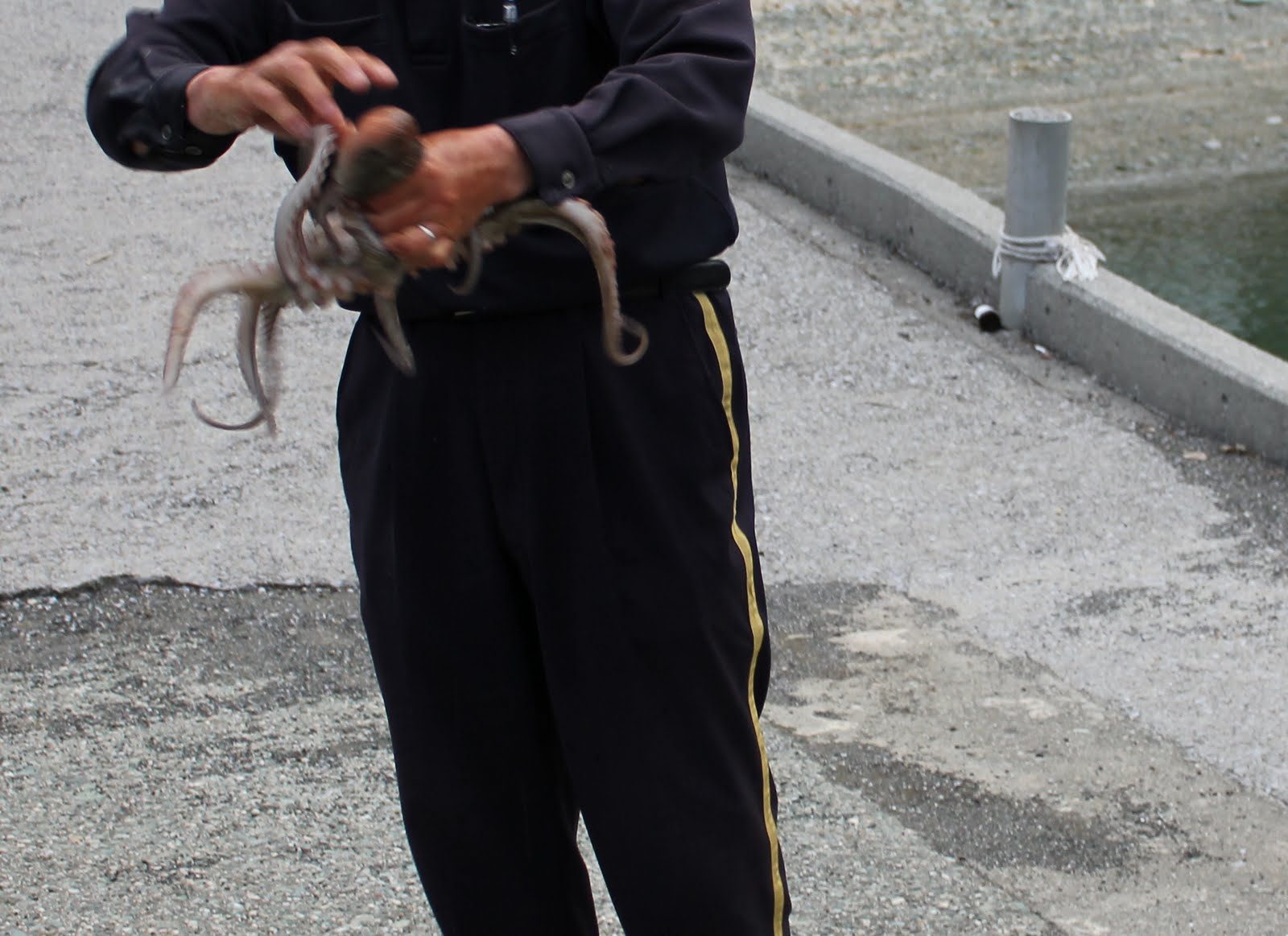
N-san pulls it off to set it down on the pavement; I hear the pop-pop-pop of the suction cups detaching.

It's still trying to prove something.


Now, I don't like octopus myself, but a lot of other people do, and this one was well appreciated by N-san and his family. I was lucky to have my camera with me that day. Ickiness aside, the finding and catching of an octopus was absolutely fascinating to watch.

This has been a snapshot of life in the Japanese countryside. Thank you.

6/23/2010

Food! ~Tabe-mono 食べ物~

(Above is a salad called kinpira-renkon. Kinpira refers to a finely chopped vegetable, usually burdock and carrot, and renkon is lotus-root. Actually, this is one of my favorite dishes. 上の写真はきんぴらレンコンのサラダです。きんぴらは、細く切った野菜のことで、普通はゴボウとにんじんですが、レンコンはロータス・ルーツです。実は、これが私の大好物の1つです。)

Let's learn some food-related words! 食べ物の単語を覚えましょう!

◆What food(s) do you like?
好きな食べ物は何ですか?
Skina tabemono wa nan deska?  *(this should really be "sukina" and "desuka", but the u sound is dropped to almost nothing in spoken Japanese)

◆What do you like for breakfast?
朝食は何が食べたいですか?
Chōshoku wa nani ga tabetai deska?

◆Do you like octopus?
タコが好きですか?
Tako ga ski deska? *, (and yes, "tako" = octopus!)

◆Would you like to try some octopus?
タコをちょっと食べてみませんか?
Tako wo chotto tabete mimasenka?

◆I like pretty much anything!
(私は)ほとんど何でも大丈夫です!
(Watashi wa) hotondo nandemo daijōbu des!

◆I can eat anything!
私は何でも食べられます!
Watashi wa nandemo taberaremas.

◆I'm sorry, but I'm full.
すみませんが、お腹いっぱいです。
Sumimasen ga, onaka ippai des. 


Be careful not to say "onaka itai des"!  It means "my stomach hurts."
(「おなかいたいです」と言い違えないように気を付けてね!意味は変わりますから。)

6/18/2010

Interested?

Here is an example of some real Ikata cuisine!

Whitebait (very young and small fish, called alternatively shirasu or chirimen in Japanese) are boiled and served whole and cold with white rice, or fried with vegetables in batter as tempura.

These are featured items at the newly established Shirasu Park cafeteria, in Ikata's Seto area. We are hoping to take you there to observe the preparation process. Now, how many of you might be interested in trying shirasu-don (chirimen on rice) or shirasu tempura?

Don't be shy, I would like your honest opinions! :)

6/16/2010

アメリカに行くまでには・・・心構え

この件に対して、レッドウイング市の友達4人が答えてくれました。

アビゲールさんは、「偏見にとらわれず、全てのことを受け入ればいいです。」

ブレーズさんは、「ここはものが大きくて広いです。トウモロコシや大豆など、穀物畑が大きい。大きな家や、広い芝生。レッドウイング市の人々は落ち着いていて、フレンドリーです。英語がまだまだというところでも、喜んで話してくれます。気を遣わず、心配せず、レラックスして、旅を楽しんでください。やれるだけのことをやってみてください。決してがっかりしませんから。」

デック・エミリーさんは、「ここに来たら、普段より牛肉などの赤身の肉はたくさん出るでしょう。そして、魚は普段より少ないと思います。英語が完璧じゃなくても、誰も気にしません。「プリーズ」と「サンキュー」だけ言っても、温かく受け取られます。」

匿名の人は、「機会を生かして、何でも体験してみてください。できるだけシャイな面を見せないで、人と積極的に接してみてください。社交的にすればするほど、楽しく過ごせるからです。」

Laundry in Japan

The majority of Japanese home washing machines run with only cold water. They are usually not accompanied by a dryer, so clothes and towels hang outside to dry, while unmentionables hang in an indoor room with good ventilation. As you can imagine, this is a good energy-saving step (or, as we say in Japan, "eco," pronounced echo) for the environment. However, if you need their services, there are a lot of dry cleaners in Tokyo, and a few around Ikata as well.


Since there isn't exactly a lot of space in people's homes for mounds of dirty clothes, families have to do the laundry every day. When you meet your host family in Ikata, you will certainly have some dirty clothes from your travels. Don't by shy; your host mother will expect you to give them to her. If you wait until the next-to-last day and then empty your backpack to reveal 14 days' worth of unwashed clothes, they probably won't be completely dry in time for your flight. (Not to mention, what mother likes that kind of surprise?)


To avoid unnecessary rough handling by the machine, people put clothes and linens inside mesh bags before washing them.


While I have heard stories from other people about clothes ripped up by a washing machine, I've never had that unfortunate experience myself, and I like to think it's because I religiously protect my garments in mesh bags. The worst that I've ever encountered was a couple of times when clothes came out with a bleach stain.


The bottom line? The unadventurous would be well advised to leave expensive, one-of-a-kind, absolute favorite clothing behind… or at least out of the washing machine.

6/14/2010

Your suggestions, please! :)

Some of our Ikata students would like to know:

"What should we know before going to America? What should we do to prepare?"

Of course, they know all about getting their passports in order and completing the U.S. ESTA form online. But so far, they don't know what they don't know yet. What advice would you give them-- to lessen culture shock? --to enable them to have more fun? --to make it easier to talk with people (i.e., through a simple catchphrase or new slang? --to prepare them for new sights, sounds, or foods? Or anything else!

Leave your answers in the combox, and I will translate them in another post.

We're all looking forward to reading your advice!

食事の写真 ♪お願い♪

みなさん、

ミネソタ州では、和食のお店が増えてきて、とても人気です。

しかし、「日本食が好き」というミネソタ人はだいたい、寿司、刺身、天ぷら、枝豆、と白いご飯のことを考えています。

そして、お寿司といっても、アメリカ誕生の「カリフォルニア・ロール」のことだと思う人もいます。

だから、お願いします。

食事・おやつ・好きな食べ物の写真を送ってくれませんか?レッドウイング市の友達へ和食を紹介しましょう!

(写真は添付ファイルにして、ikataドットcirアットマークgmailドットcomへ送ってください。 ^^)